The PSUs and Banks That Hire Athletes on Sports Quota: Most Families Have Never Heard of Them
IndianOil employs over 150 sportspersons including Sharath Kamal, Manika Batra and Hima Das, who was appointed HR Officer at 18 on the basis of her world junior 400m gold. ONGC runs both a scholarship scheme for under-20 athletes and a separate recruitment programme. Bank of Baroda and SBI release sports quota notifications every year. The eligibility threshold at Bank of Baroda explicitly includes junior national championships and Khelo India Games.
The conversation about government employment for Indian athletes almost always mentions two employers: the Indian Army and the Indian Railways.
Both are real and both matter. The Army’s sports quota, which gave Neeraj Chopra the rank of Naib Subedar at 18, and the Railways’ Petroleum Sports Promotion Board, which employed Bajrang Punia and Vinesh Phogat throughout their international careers, are documented and accessible routes.
But there is a third category of employer that most sports families in India have never been told about. Public Sector Undertakings and nationalised banks hire athletes through sports quota every year. The scale of this hiring, across the oil sector, the steel sector and the banking sector, is significant. The eligibility benchmarks are accessible. The jobs are permanent, salaried positions with allowances, career progression and the expectation that the athlete continues competing.
IndianOil alone currently employs more than 150 sportspersons, including over 20 Olympians. It has been doing this since 1966.
IndianOil: The Largest PSU Sports Employer in India
The journey started with a badminton player.
Dinesh Khanna joined Indian Oil Corporation Limited in 1966. He went on to win the National Badminton Championship, a bronze medal at the 1966 Commonwealth Games and a bronze medal at the 1974 Asian Games. His appointment was the beginning of what became one of the most sustained sports employment programmes in Indian public sector history.
IndianOil formalised its sports policy in 2003, creating a structure that covered recruitment, performance evaluation, promotion, competition facilities and a code of conduct. The policy established the framework that still governs how the corporation recruits and supports sportspersons today.
The current roster of IndianOil sportspersons includes names that are now known across the country. Achanta Sharath Kamal, who has won multiple Commonwealth Games gold medals in table tennis and represented India at several Olympics, is an IndianOil employee. Manika Batra, who became the first Indian woman to win a table tennis gold at the Commonwealth Games in 2018, is an IndianOil employee. Rohan Bopanna, India’s highest-ranked tennis player for an extended period, is an IndianOil employee. P Gopichand, who won the All England Badminton Championship in 2001 and went on to become India’s most celebrated badminton coach, was an IndianOil sportsperson. K Srikanth, former world number one in badminton, is an IndianOil employee.
What this list represents is not a collection of people who became famous and were then given honorary positions. These are people who were recruited through IndianOil’s sports programme, given employment, provided with competition support and continued their careers within that structure.
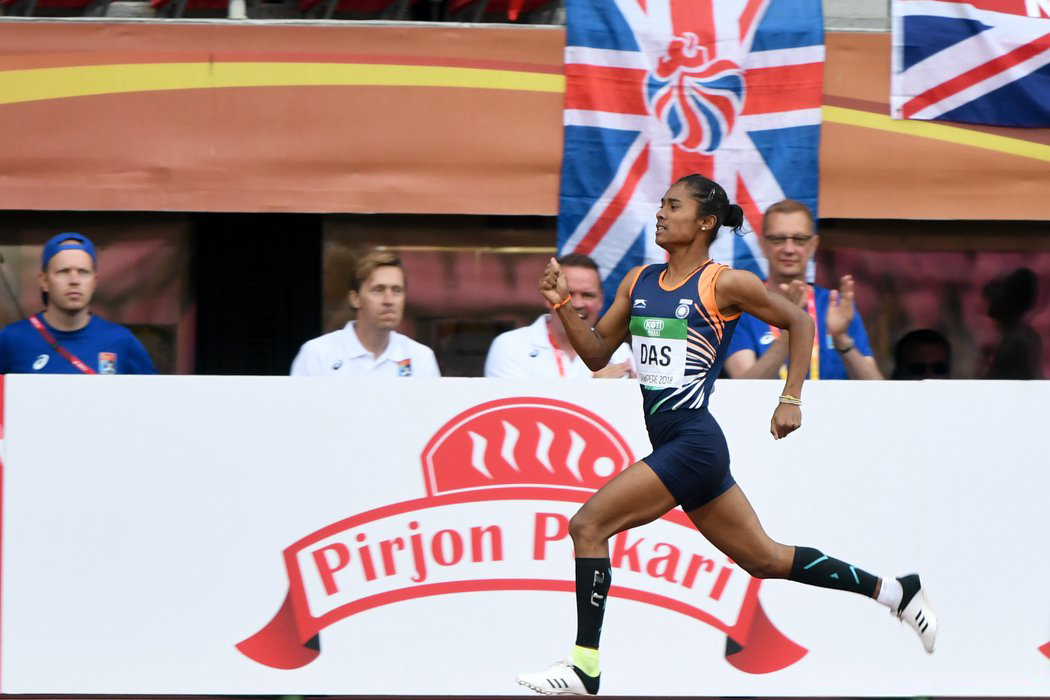
Hima Das: HR Officer at 18, On the Basis of a World Junior Record
The example that most directly illustrates what this system offers to young athletes is Hima Das.
Hima Das was born in 1999 in Dhing, Assam. She grew up in a farming family and came to athletics relatively late, first training seriously in her mid-teens. She is a natural 400-metre runner, with the speed and endurance distribution that coaches recognize as a specific gift.
In July 2018, at the IAAF World Under-20 Athletics Championships in Tampere, Finland, she ran the 400 metres in 51.46 seconds, winning the gold medal. She was 18 years old. It was the first time any Indian athlete had won a gold medal at a global track and field championship at any age level.
In October 2018, IndianOil Corporation appointed her as an HR Officer at Grade A level.
The appointment came three months after the world junior gold. She had not yet won a Commonwealth Games individual medal. She had not yet run the five consecutive gold medals across European athletics meets in 2019 that would make her story known across India. IndianOil recruited her when she was an 18-year-old from Assam who had just done something no Indian track athlete had ever done.
IndianOil covered all costs of her travel and participation in national and international competitions. The corporation described the arrangement as mutually beneficial: the athlete receives stability, income and institutional support; IndianOil receives the representation and the association with competitive performance at the highest level.
The stability that IndianOil provided mattered for a specific reason. Hima Das came from a family without the financial resources to fund international training and competition independently. The appointment did not interrupt her athletic career. It funded it.
ONGC: The Scholarship Pipeline and the Recruitment Pathway
Oil and Natural Gas Corporation operates two separate but related sports programmes.
The first is the ONGC Sports Scholarship Scheme, targeted at athletes between 15 and 20 years of age. The scheme awards 250 scholarships annually, with 50 per cent reserved for women. The monthly award ranges from Rs 15,000 to Rs 30,000, depending on the level of athletic achievement. Family income must not exceed Rs 5 lakh per year. Selection is based on sports performance in recognized competitions, and the scheme covers multiple disciplines including athletics, badminton, boxing, hockey, wrestling, shooting and others.
This scholarship does not automatically lead to employment. But it creates visibility within ONGC’s sports ecosystem and provides financial support during the years when athletes are building their competitive profile.
The second programme is ONGC’s direct sports quota recruitment, which is separate from the scholarship and targeted at athletes between 18 and 30 years of age. In 2026, ONGC released notifications for 30 posts across badminton, table tennis, lawn tennis, basketball, hockey, kabaddi and volleyball. Positions are offered on a stipend basis within the Corporate Sports Division, with the expectation of institutional representation in competitions.
Both pathways require documented achievement in recognized sports. The recruitment notification specifies which performance levels qualify, and these are published in the full notification on ongcindia.com.
The Petroleum Sports Promotion Board
Beyond IndianOil and ONGC individually, the oil sector operates a collective sports body: the Petroleum Sports Promotion Board.
PSPB coordinates sports activities across the public sector oil companies, which include ONGC, IOCL, BPCL, HPCL, GAIL and others. The board organises inter-PSU competitions and enables oil sector employees to compete together as a unit in national tournaments.
The practical significance for an athlete is that employment at any of these organizations places them within this ecosystem. BPCL is the principal sponsor of the Indian Olympic Association for the Paris 2024 to Los Angeles 2028 cycle. HPCL, GAIL and others each maintain their own sports programmes within the broader PSPB structure.
Nationalised Banks: A Route Most Athletes Don’t Know Exists
Indian nationalised banks recruit athletes on sports quota every year. The scale varies by bank and by year, but three banks in particular run regular, documented programmes.
State Bank of India released a notification in 2024 for 68 posts across clerical and officer categories for meritorious sportspersons. The sports covered were basketball, cricket, football, hockey, volleyball, kabaddi, table tennis and badminton. Selection is based on sports achievement and trials, not on a written examination.
Bank of Baroda released a notification in 2026 for 30 clerk posts for sportspersons. The eligibility for Bank of Baroda’s programme is worth quoting precisely because it is more accessible than most families assume: candidates must have represented their state or India at national or international level, or be medal winners in junior national championships, Khelo India Games, university games or SGFI events. No written examination is required. Selection is through trials. The pay scale for clerk posts runs from Rs 24,050 to Rs 64,480, alongside allowances.
Punjab National Bank released a notification in 2025 for 9 posts specifically for hockey players, as Office Assistant or Customer Service Associate. PNB maintains an active hockey programme and recruits specifically for institutional representation in national-level hockey competitions.
The bank recruitment pattern differs from PSU recruitment in one important respect: the sports covered tend to be a shorter list, and the posts available each year are fewer than what PSUs like ONGC or IndianOil offer. But the eligibility criteria at Bank of Baroda in particular makes this route worth tracking. Junior nationals, Khelo India Games and SGFI events are named as qualifying achievements. These are competitions that serious state-level athletes compete in before they are anywhere near Olympic or Asian Games consideration.
What This System Is Designed to Do
PSU Sports Quota: The Four Main Employers
IndianOil
India's largest PSU sports employer. 30+ Olympic/international athletes employed. Job grade: HR Officer / Executive. Sports: athletics, hockey, boxing, shooting, wrestling.
ONGC
Scholarship pipeline into employment: scholarship from junior level, employment on senior performance. Sports: weightlifting, boxing, athletics.
SBI
Sports quota for banking roles. Less visible than PSUs but a consistent recruiter. Sports: cricket, hockey, football.
PSPB
Petroleum Sports Promotion Board: covers IOC, BPCL, HPCL, GAIL. Annual national tournaments. Employment via member PSUs.
PSU sports quota is not a widely advertised programme. Most athletes who use it find out through coaches or federation contacts, not public announcements.
PSUs and banks recruit athletes for the same reason the Army and Railways do. They want institutional representation in competitions, they want the discipline and competitive instinct that serious athletes bring to any professional role and they want the association with high-level sport that benefits the organization’s public profile.
For the athlete, the benefit is financial stability during the years of competitive career, the institutional support to continue training and competing without income uncertainty and a career structure that continues after the competitive phase ends.
IndianOil’s programme has been running for sixty years. The system does not depend on any individual policy decision or political priority. It is structural, recurring and documented.
The athletes who access it are not all Olympians. Sharath Kamal and Manika Batra became Olympians after joining IndianOil’s programme, not before. Hima Das became the athlete the country now knows after IndianOil gave her a stable position in 2018. The route into these programmes starts at a level that is within reach of serious junior national-level athletes in recognized sports.
What to Do This Week
Go to iocl.com and navigate to the Sports section. Read what IndianOil's current sports programme covers: which sports are included, what the employment structure looks like for sportspersons and what a sports scholarship from IndianOil provides versus a direct employment appointment. These are two separate things and the distinction matters. Understand both before forming any opinion about whether this route is relevant to you.
Go to ongcindia.com and find the ONGC Sports Scholarship Scheme notification for the current year. Check the eligibility criteria against your age, your family income and your recent sports achievement. If you are between 15 and 20 with a performance in a recognized competition, read the criteria carefully. Then check the separate ONGC sports recruitment notification if you are 18 or above. These are two separate notifications, two separate programmes and two separate eligibility checks.
Search for "Bank of Baroda sports quota recruitment 2026" and "SBI sports quota recruitment" for the current year. These notifications are released annually, and the closing dates are firm. Read the full notification for your bank of interest: which sports they are recruiting in, what performance level qualifies and what the application process looks like. If your sport is on the list and your achievement meets the threshold, the application window is the thing to track.