Three Sisters, No Private Academy: What the Borgohain Family Did Instead
Tiken Borgohain raised three daughters in a village in Assam without the finances for private sports coaching. His twin daughters Lima and Licha competed nationally in Muay Thai. His youngest, Lovlina, showed up to a Sports Authority of India trial at her school in 2012, was spotted by coach Padum Boro and was selected for the SAI centre in Guwahati. Nine years later she won a bronze medal at the Tokyo Olympics. The pathway was government, not private.
Baramukhia is a village in Golaghat district, Assam. Tiken Borgohain, a small-scale businessman, raised three daughters there. The family did not have the finances for private sports coaching. They did not have access to the infrastructure that produces champions in the sporting imagination: the residential academies with imported equipment, the foreign coaches, the performance science support.
What they had were three daughters who wanted to compete, a community that thought this was unusual and a government sports system that was looking for exactly what the Borgohain family had to offer.
The youngest daughter was Lovlina.
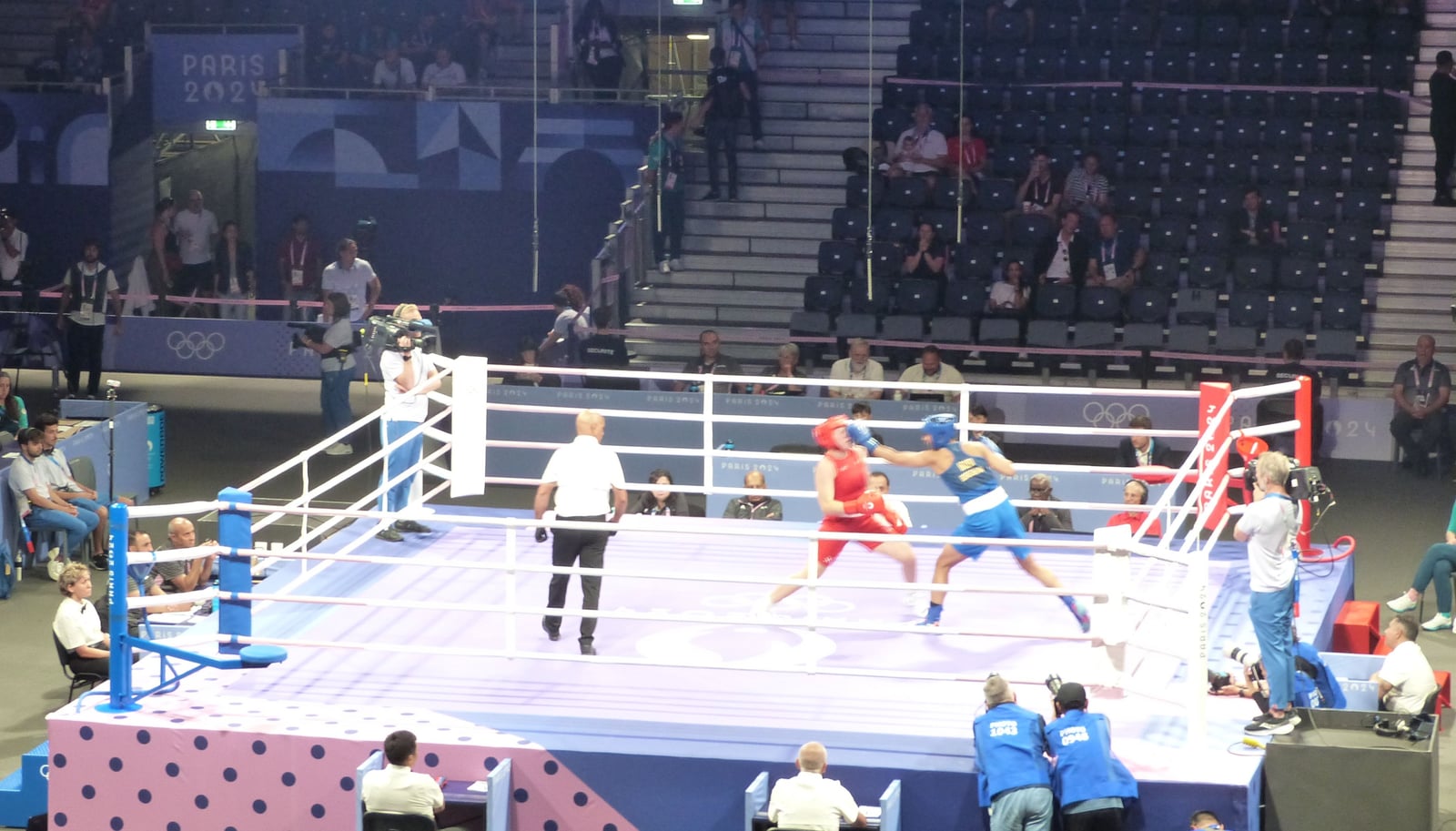
The Sisters Who Came First
Lima and Licha Borgohain are Lovlina’s elder twin sisters. Before Lovlina took up boxing, Lima and Licha had already entered combat sports, specifically Muay Thai, a striking discipline that uses punches, kicks, elbows and knees. Both competed at the national level in Muay Thai.
This matters for understanding what the Borgohain household was and was not. It was not a family that stumbled into sport by accident. By the time Lovlina was old enough to make her own choices about training, she had two sisters who had already gone through the process of becoming serious competitors in a physically demanding discipline. She grew up watching what that looked like from inside the family.
She began training in Muay Thai herself, following what her sisters had started.
The decision to take up combat sports was not met with enthusiasm from the village. Golaghat had a specific set of expectations about what daughters of a family with limited income should be doing with their time and bodies. Combat sports, which involved hitting and being hit, were not among them. The absence of sons in the Borgohain household was itself a source of comment from neighbors and community members, who interpreted it as a kind of misfortune.
Mamoni Borgohain, the children’s mother, had her own response to the community’s position. She told her daughters that the critics were a reason to compete harder, not a reason to stop.
What the Family Could Not Afford
Private sports academies in India operate on a fee model. Residential programs at established coaching centers charge for accommodation, meals, equipment and specialized instruction. The better the program, the higher the cost. For families outside the metropolitan clusters where most elite private academies are located, the cost also includes transport or relocation. For a small-scale businessman in Golaghat running a household with three daughters in combat sports, none of this was within reach.
The family’s financial position meant that any pathway had to come through a system that did not charge what it was worth. That system existed. Most families in the Borgohains’ situation did not know it existed.
The Sports Authority of India runs training centres across the country. Entry is through trial, not through a fee. Selection is based on potential, not on what a family can pay. Once selected, a trainee receives coaching, facilities, board and lodging and competition exposure without a tuition cost to the family.
The question was whether anyone in the system would see what was in front of them.
The Trial at School
In 2012, when Lovlina Borgohain was fourteen, a trial was conducted at her school. The Sport Authority of India’s outreach process sometimes works this way: coaches visit schools and district-level sports events looking for athletes who have not yet entered any formal programme.
Padum Boro, a boxing coach, was at that trial. He put Lovlina through a set of basic assessments: punching bag technique, speed punching, physical tests that boxing uses to identify raw potential in an untrained athlete. He described his assessment afterward in an interview with Olympics.com: “I thought she could be made into a boxer.”
That sentence carried a specific meaning. It did not say she was already a boxer. It said she had the physical and coordinative qualities that, with proper training, could be developed into a competitive career. Padum Boro was identifying raw material, not a finished product.
Lovlina had not been training in boxing specifically: her background was Muay Thai, through her sisters. But the underlying physical qualities that Muay Thai and boxing share were visible. The coach saw them.
What Followed the Trial
After the trial, Lovlina Borgohain was selected for training at the SAI centre in Guwahati. This meant relocating: Guwahati is not Golaghat, and training at the centre required her to be there, not commuting from a village three hours away.
Her father, reflecting on this period later, said he was glad she could eat three meals a day at the centre. This is not a throwaway remark. It describes the specific quality of the proposition the government system was making to the family: we will feed your daughter, train her and cover the costs of developing what the coach has identified. The family’s financial situation did not have to be the ceiling of the athlete’s development.
The centre provided structured boxing coaching, access to facilities and the competition exposure that moves an athlete from local trial to national-level competition. Within the government system, progression follows a documented pathway: local trial to district to state to national, with SAI infrastructure available at each stage for athletes who perform.
Lovlina competed. She kept competing. The results at each level justified the next level of support.
What the Career Became
Lovlina Borgohain: SAI to the Olympics
No private academy. No paid coaching. Government infrastructure at every stage.
Lovlina Borgohain won a bronze medal in the welterweight category at the Tokyo 2020 Olympics, held in 2021. She was twenty-three years old. It was India’s third boxing Olympic medal, after Vijender Singh’s bronze in Beijing and Mary Kom’s bronze in London.
The journey from Padum Boro’s trial assessment in 2012 to the Olympic podium in 2021 was nine years. It was nine years of training within a government system that had the resources the family did not, structured around competitions that progressively raised the standard she was being prepared for.
Her twin sisters, Lima and Licha, competed at national level in Muay Thai. They did not reach the Olympic programme. They made it to the level the combination of their talent and the available support took them to.
The Borgohain family produced three serious competitive athletes. One of them reached the Olympic podium. The others built athletic careers that reached the national level. All three did it without a private academy, without a significant family financial investment and without access to the infrastructure that most families assume is the only route.
What the Community Saw
The community that had pitied Tiken and Mamoni Borgohain for having no sons watched Lovlina win an Olympic bronze medal in Tokyo. There is documented footage of the village, and Golaghat district more broadly, erupting in celebration when the result came in.
The community did not change its values. It responded to visible, undeniable evidence that the daughters of the family it had been pitying had done something none of its sons had done.
Mamoni Borgohain had told her daughters to prove the critics wrong. The critics had been proved wrong about as completely as it is possible to prove critics wrong.
What This Family’s Journey Shows
The Borgohain family’s story is sometimes told as a triumph-over-adversity narrative, which it is. But the specific lesson it contains is more practical than that framing suggests.
The family did not find a private academy they couldn’t afford and somehow pay for it anyway. They did not have a patron. They did not get a lucky break from a wealthy sponsor. What they had was three daughters who showed up to a government trial, and one of them was seen clearly by a government coach who had the professional formation to recognize what he was seeing.
The sports quota into a private academy was never available to the Borgohains. The sports trial for the SAI centre was. That is the specific difference.
Most families in similar situations do not know the SAI trial process exists. They do not know that admission to training infrastructure through government systems is based on athletic potential, not on the ability to pay. They assume the gap between where they are and where competitive sport happens is a financial gap. In many cases, it is not. It is an information gap.
The Borgohain family got lucky in one specific way: a coach came to the school. That coach would not have come if the system had not sent him there. The system sent him there because that is how the Sports Authority of India’s outreach works.
What to Do This Week
Go to sportsauthorityofindia.nic.in and look up the SAI Training Centre scheme. Find which disciplines are covered and which centres are in your state. The trial process is described on the site. If your state has a SAI centre in your sport, the trial is the relevant pathway to understand, not a private academy's fee structure.
Contact your district sports authority. In Lovlina Borgohain's case, the pathway in was a coach visiting a school. That visit did not happen because the Borgohain family arranged it. It happened because SAI outreach reaches districts if you engage with the district sports structure. Find out when the next talent identification trial is in your district and your sport. If you cannot find this through the district authority, contact the state sports association for your sport directly.
If financial constraints are making the conversation about a sports career feel impossible: make a list of what you think the career requires and what each item costs. Then check, specifically, which of those items has a government equivalent that costs nothing. Equipment, coaching, competition exposure and residential training all have government-funded pathways in most major sports. The Borgohain family did not know these existed until a coach appeared at a school. This platform exists so that families know before the coach shows up.