Two Sisters, Two Champions: Geeta and Babita Phogat and What Each of Them Built
Geeta Phogat won gold at the 2010 Commonwealth Games, the first by any Indian woman wrestler. Babita Phogat won gold at the 2014 Commonwealth Games. They trained under the same father in the same household in the same discipline. After the medals, they went in entirely different directions: Geeta stepped back from elite competition; Babita entered politics. Both choices are valid. The Phogat sisters are a documented answer to the question of what sport leads to.
Balali is a village in Charkhi Dadri district, Haryana. Mahavir Singh Phogat, a former wrestler, lived there with his family. He had competed himself and had not reached the level he had aimed for. When his daughters were young, he made a decision that his village found difficult to accept: he was going to train them as wrestlers.
The objections from the community were specific. Wrestling was a contact discipline requiring physical strength, close-quarters engagement with opponents and the kind of daily grind that the village had only ever expected of its sons. The Phogat daughters were being prepared for something that Balali, in the 1990s, had no framework for.
Mahavir Singh Phogat’s response to the community’s position is documented. He said, in effect: if a woman can become Prime Minister, she can become a wrestler.
He trained his daughters anyway.
Geeta’s Start
Geeta Phogat, the elder of the two sisters at the centre of this account, was born in 1988. She began serious wrestling training under her father from a young age, working through the progressive levels of the discipline: local tournaments, state championships, national selection.
The training was not celebrated in Balali. It was accommodated, and then tolerated, and then eventually respected as the results came in. This is the arc most families in sports-resistant communities know: the community’s position does not change through argument. It changes through visible evidence that its assumptions about what is possible were wrong.
Geeta provided that evidence progressively. State-level results led to national-level selection. National-level selection led to international competition. International competition led to the Commonwealth Wrestling Championship in 2007, where she won a gold medal. She was nineteen.
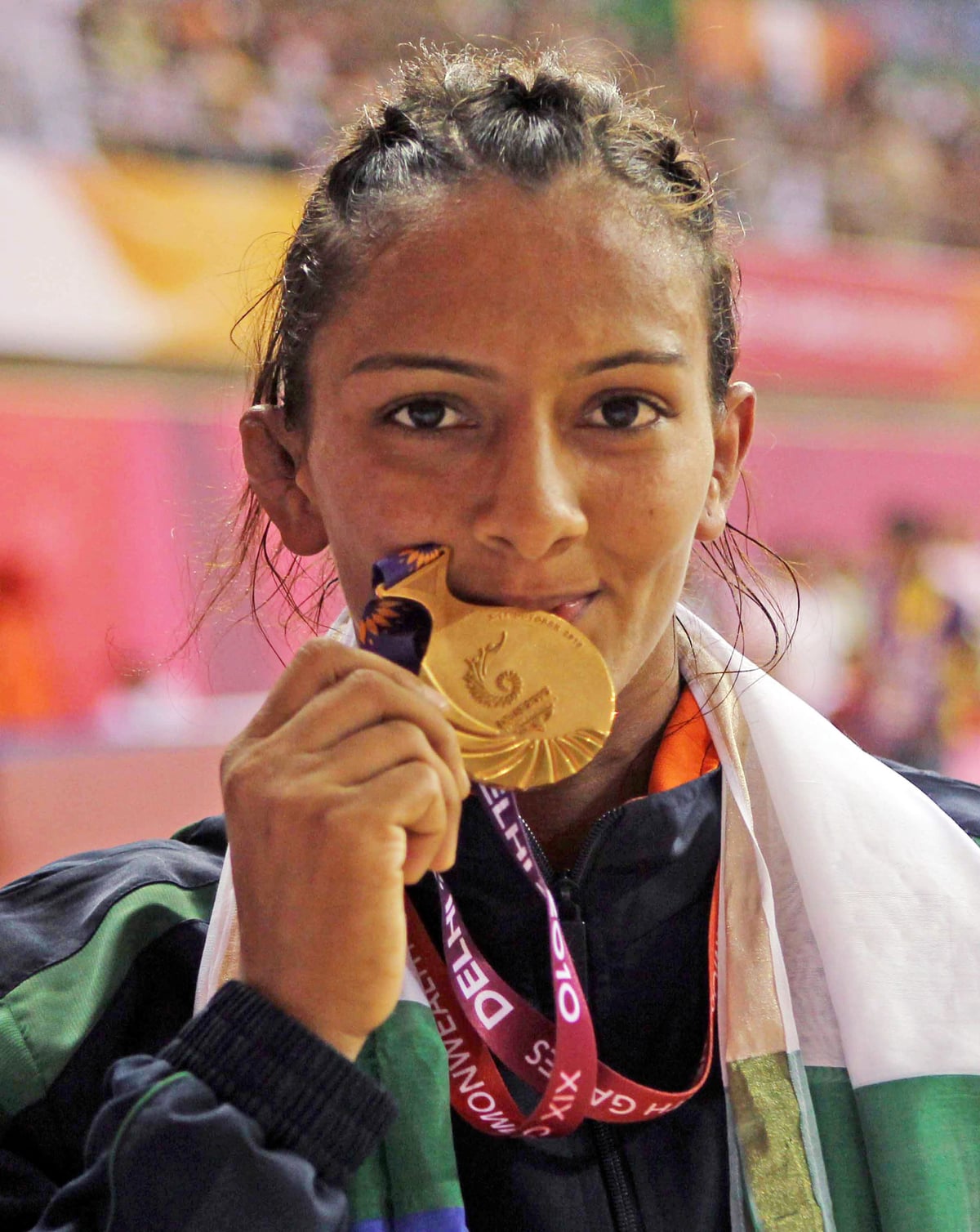
The trajectory continued. Geeta competed at the 2010 Commonwealth Games in Delhi in the women’s 55kg freestyle wrestling category. She won the gold medal.
It was the first gold medal by a female Indian wrestler at the Commonwealth Games. No Indian woman had done it before. The sport that Balali village had struggled to accept its daughters entering had produced, from one of its daughters, a result that was historically unprecedented in Indian wrestling.
Babita’s Parallel Journey
Babita Phogat, born in 1989, was trained in the same household under the same father. The conditions Geeta navigated (community skepticism, physical demand, the absence of any roadmap from a Haryana village girl’s life to a wrestling medal) were identical for Babita. They trained together. They competed at parallel levels.
They also competed against each other.
In 2012, at the Commonwealth Wrestling Championship in Jalandhar, Babita beat Geeta in competition. The circumstances are documented: Babita won the 51kg gold at that event, and she has spoken since about what competing against and defeating her sister meant for her own development. Winning against someone who had trained you, who shared your household and your coach, who had already stood on an international podium, told Babita something about her own ceiling that winning against anyone else could not tell her.
She won the gold medal at the 2014 Commonwealth Games in Glasgow, in the 55kg category. She followed it with a silver at the 2018 Commonwealth Games in Gold Coast, competing in the 53kg category.
Two sisters. Two Commonwealth Games gold medals. Four years apart, in the same discipline, from the same training environment, trained by the same father who had once had to argue with his village about whether his daughters should be wrestlers at all.
What the Film Captured and What It Did Not
In 2016, Aamir Khan starred in Dangal, a film based on the Phogat family’s story. It told the story of Mahavir Singh Phogat and his daughters primarily through the arc of Geeta’s career, with Babita as a significant presence. The film was one of the highest-grossing Indian films of the decade.
What the film captured was the core documented truth: a father who believed in his daughters against the resistance of his community, daughters who competed at the highest level and proved that belief justified.
What any film necessarily compresses or dramatizes is the years of daily work that produce the results it shows in a two-hour story. The training that began in childhood, the state and national competitions, the injuries and the losses that are not shown: these are the structure under the highlights.
By the time Dangal released, Geeta was twenty-eight and Babita was twenty-seven. The story the film told was about who they had been. The lives they were living in 2016 were different from what either the film or the audiences watching it were paying attention to.
After the Medals
Geeta Phogat’s competitive career was significantly affected by injuries in the years following 2016. She married Ram Avtar Godara, an Indian wrestler, in 2016. Her active international competition became limited as injuries disrupted her ability to compete at the level she had maintained through the earlier part of her career.
She remained publicly visible through other routes. In 2017, she appeared as a contestant on Khatron Ke Khiladi, a stunt-based reality show. In 2025, she and Babita appeared together on the reality programme Pati Patni Aur Panga. These are not the contexts in which people imagine a two-time Commonwealth champion spending her post-sport years when they are young and watching a World Championship competition.
But Geeta Phogat did not disappear. She stepped back from high-performance wrestling and into a different public presence, one shaped by her identity as a Phogat, as a champion, as a figure whose story people knew, but not one organised around active competition at the elite level.
Babita Phogat took a completely different direction.
In 2019, she joined the Bharatiya Janata Party. She became a BJP spokesperson and stood as a candidate in the Haryana state assembly elections that year, contesting from the Dadri constituency. She lost, to Sombir Sangwan. But the decision to enter politics was not a failure of the attempt to enter politics; it was a choice to do something entirely different with the public presence that wrestling had built.
The two sisters had trained under the same father, competed in the same discipline, won gold medals at the same international competition series and then gone in directions that had very little overlap with each other or with where the wrestling had taken them.
What Neither Life Suggests About the Other
Two Sisters, Two Career Arcs
Both gold medals came four years apart. Neither sister's path was the only right path.
It would be easy to read Geeta’s trajectory (retirement from elite competition, reality television, relative quiet) as the lesser outcome. It would be equally easy to read Babita’s entry into politics as an abandonment of the wrestling that produced her platform, or as a better use of it.
Both readings are wrong.
Geeta Phogat built a marriage, a family and a life shaped by the choices available to someone who had given what elite sport requires and then decided what she wanted next. Those choices are hers. The Commonwealth Games gold does not obligate her to any particular use of the platform it built. She earned the right to make the choice she made, including the choice to step away from public competitive life on her own schedule.
Babita used the platform wrestling built to enter a different kind of competitive arena. Indian politics is not simple, and losing an election in your first attempt is not unusual. But the decision to try was an extension of the competitive identity that wrestling built, not a departure from it.
Their father trained them to compete. They competed. They won. What they did with what they won is their own business, and it turns out they did very different things with it.
What This Family’s Story Is For
The Phogat family’s story is known primarily as a story about what a father believed and was proved right about. What is less discussed is what the daughters did after the proof was in.
This matters for families who are currently in the middle of the argument about sport and what it leads to. The question “what will sport lead to?” almost always has the Paris Olympics or a national jersey in mind as the answer. What Geeta and Babita Phogat show is that the answer is more varied than that, and more personal.
Both sisters made it to the highest level the sport offered in India at the time. Both were Commonwealth Games gold medalists. Both competed internationally across multiple cycles. After that, they became different people doing different things, in ways that had nothing to do with whether they had “made it.”
The argument about whether sport leads somewhere is not settled by what happens at the elite level. It is settled by who comes out the other end of the commitment, and what they are capable of after it. Geeta Phogat is capable of a great deal. So is Babita. What they chose to do with that capability is different. Both choices are valid.
What to Do This Week
Read specifically about Mahavir Singh Phogat's decision to train his daughters, not from the Dangal film but from documented interviews and profiles. His reasoning is available in the public record. What he was responding to (community resistance, his daughters' potential, his own experience as a wrestler who had not reached the level he wanted) is documented. Understand his reasoning before using his story as evidence about any position you hold.
If you are a parent asking what sport will "lead to" for your child: look at Geeta and Babita Phogat and ask the question about both of them honestly. Both had the same training, the same father, the same discipline and the same level of competitive achievement. Both lead entirely different lives. The question of what sport "leads to" does not have a single answer, and the Phogat family is a documented example of why.
Look up the Sports Authority of India's current wrestling programme and the Haryana state wrestling development pathway. The Phogat sisters came through a home-trained route that relied on their father's expertise. That route is not available to most families. What is available is documented. Find out what the accessible pathway looks like in your sport and your state before concluding that the Phogat route is the only route or that it is replicable without the specific conditions the Phogat family had.